
Most people judge a website by the tip of the iceberg: the homepage layout, photos, colors, and buttons. That visible layer matters. It is also only a fraction of the work that determines whether the site is found, trusted, converts, and still working a year from now.
At Intrepid Network, we have been building websites and marketing systems in San Diego since 1996. Clients see the finished front end. Under the waterline, we map paths, structure copy, harden security, test devices, and document the build so the site can grow without being rebuilt from scratch. The iceberg below is a useful picture of that hidden work.
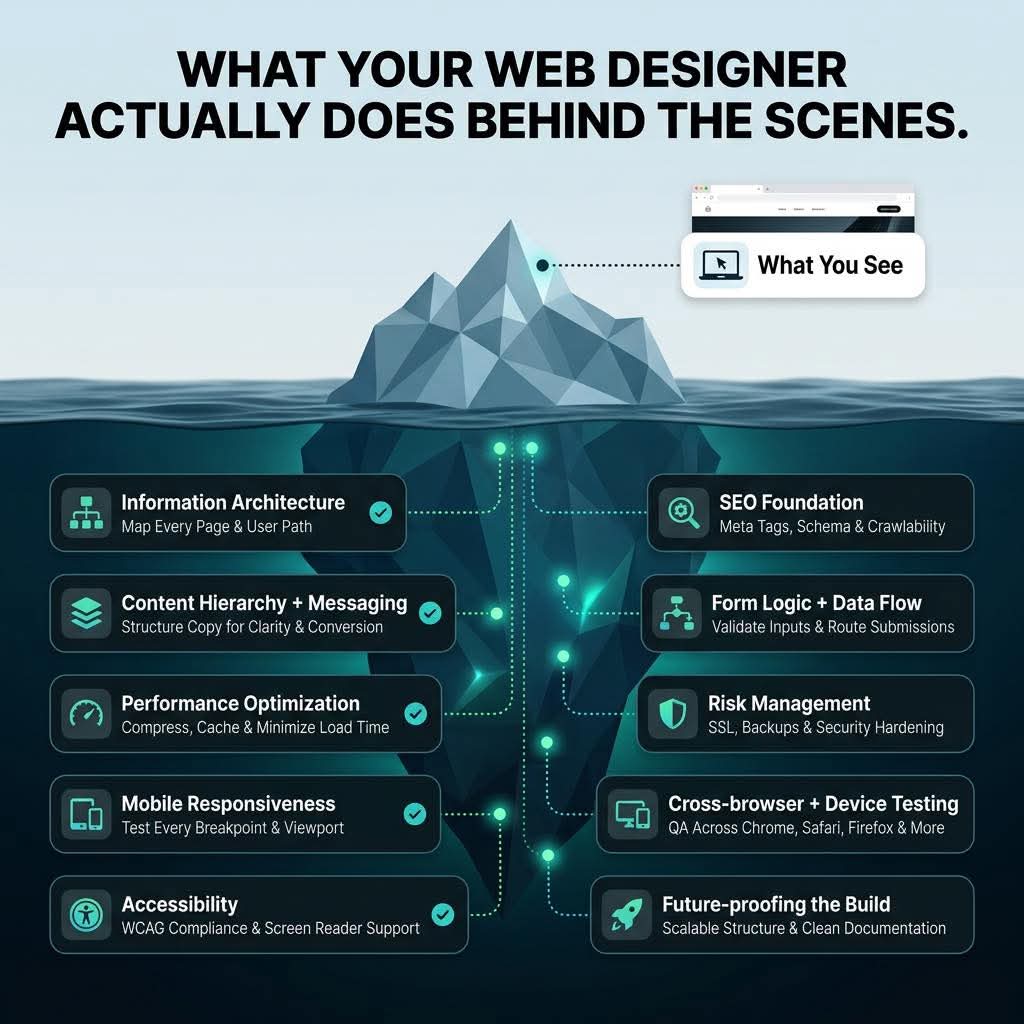
What you see is the site. What we do is everything that holds it up.
Information Architecture: Map Every Page and User Path
Before a pixel is placed, we decide how people move through the site. That means listing every page, grouping related content, and drawing the paths a visitor should take from the first click to a call, form, purchase, or donation.
Poor architecture looks like a pretty homepage with dead ends. Strong architecture looks like a museum, chamber, or product catalog that still makes sense when it grows from 20 pages to 200. This is the same architecture-based approach we use on client projects: functional front ends sitting on a content structure that staff can actually manage.
Content Hierarchy + Messaging: Structure Copy for Clarity and Conversion
Design cannot rescue unclear copy. We organize headlines, supporting text, and calls to action so the most important message is seen first, on every screen size. That includes brand storytelling, service descriptions, and the intentional content we write or refine before it goes into Drupal or WordPress.
Hierarchy is not decoration. It tells a first-time visitor what you do, why it matters, and what to do next without making them hunt.
SEO Foundation: Meta Tags, Schema, and Crawlability
Search engines and AI systems do not “see” a website the way a person does. They read titles, headings, structured data, internal links, and clean HTML. We build that foundation from the start: meta tags, schema where it helps, semantic markup, and a crawlable structure.
This is also why we favor platforms that produce meaningful HTML. Semantic structure helps traditional search and the newer work of generative engine optimization, where AI tools need to understand and quote a page accurately.
Form Logic + Data Flow: Validate Inputs and Route Submissions
A contact form that looks finished but drops messages, fails validation, or never reaches the right inbox is worse than no form at all. Behind the scenes, we define required fields, spam controls, confirmation behavior, and where submissions go: email, CRM, ticket queue, or a private admin screen.
The goal is simple. When someone takes the time to reach out, the message arrives, the data is usable, and the visitor knows it worked.
Performance Optimization: Compress, Cache, and Minimize Load Time
Google has long noted that if a page takes longer than about three seconds to load, most visitors leave. Those bounces cost inquiries and sales. We compress images, cache pages, trim unused scripts, and pair the CMS with a CDN when traffic or geography demands it.
Some of our sites have to survive sudden bursts of attention, not just a quiet Tuesday afternoon. Performance work is not a luxury add-on. It is how the site stays usable when it finally gets the traffic you wanted.
Risk Management: SSL, Backups, and Security Hardening
A public website is a target whether the business is large or small. We put encryption in place, keep core, modules, and plugins current, restrict what the public can reach, and make sure there is a restore path if something fails.
Hosting, monitoring, and routine updates are part of that same risk work. Uptime is not luck. It is maintenance, backups, and a stack that can be patched without taking the whole site down.
Mobile Responsiveness: Test Every Breakpoint and Viewport
Most visits now start on a phone. “Looks fine on my laptop” is not a test plan. We design mobile-first, then check the layout at the breakpoints where navigation, forms, and type start to break.
Buttons need to be tappable. Forms need to be completable with a thumb. Hours, maps, and calls to action need to stay visible when the screen is small. Responsiveness is tested, not assumed.
Cross-Browser + Device Testing: QA Across Chrome, Safari, Firefox, and More
A site can look correct in one browser and fail in another. We check the major browsers and a realistic mix of devices so menus, checkout flows, media, and forms behave the same way for the people who actually use them.
This is unglamorous work. It is also the difference between “we launched” and “customers can complete the task they came to do.”
Accessibility: WCAG Compliance and Screen Reader Support
The web is for everyone. Accessibility is not a badge at the bottom of the footer. It is contrast, heading order, keyboard access, alternative text, form labels, and markup that a screen reader can interpret.
Intrepid Network works to WCAG 2.1 A/AA on client sites. Better accessibility widens the audience, reduces legal risk, and usually improves SEO and usability for every visitor, not only people who use assistive technology.
Future-Proofing the Build: Scalable Structure and Clean Documentation
The last hidden layer is the one clients feel years later. We build on a content model that can accept new pages, events, products, or staff bios without a redesign. We keep the code and configuration understandable. We document how the site is put together so the next update is not an archaeological dig.
That is how a chamber site, a museum site, or a product site stays useful after launch: scalable structure, honest documentation, and a process that continues after the ribbon is cut.
How This Fits Our Process
None of the work below the waterline is a surprise add-on in our studio. It is built into the way we take on projects:
- Discovery. We meet to name goals, audience, budget, and what “done” looks like, then write a Statement of Work.
- Research. We look at competitors, partners, and how people already try to find you.
- Design and development. You review at defined points. Architecture, content, accessibility, and performance are designed together, not patched on at the end.
- Launch. We put the site live and help announce it through the channels that actually reach your audience.
- Analyze and brand management. Reports, updates, hosting, security, and content keep the site from quietly decaying.
If a proposal only prices the visible tip of the iceberg, the rest of this work is either missing or will show up later as change orders, outages, or a rebuild.
What You Should Ask Before You Hire
When you compare web designers, look past the mockup. Ask who will:
- Map the pages and user paths before design begins
- Structure the copy for scanning and conversion
- Set up metadata, headings, and crawlable HTML
- Make forms validate and actually deliver submissions
- Measure and improve load time
- Handle SSL, backups, and updates
- Test phones, tablets, and more than one browser
- Meet WCAG rather than hoping contrast “looks fine”
- Leave you with a site you can grow and a record of how it was built
Those answers are the difference between a page on the internet and a working digital storefront.
If you want a site where the work under the waterline is planned, not improvised, review our focus and process or request a meeting. We will talk through your goals, your current site, and what it would take to build the part visitors never see — the part that keeps the part they do see working.